
Quick Answer
Procrastination is usually not a motivation problem. It is an emotion regulation problem. You delay tasks not because you are lazy, but because your mind is trying to avoid discomfort like fear of failure, overwhelm, perfectionism, or boredom. The most effective way to stop procrastinating is not to force more motivation. It is to reduce the emotional friction around starting.
You have told yourself you will start tomorrow.
Or after lunch.
Or once you feel ready.
But that feeling never quite arrives.
That is the trap. Motivation is often the result of action, not the prerequisite for it. Waiting to feel motivated before you begin is one of the most common reasons people stay stuck, not just in their to-do list, but in life itself.
If you want to stop procrastinating without forcing yourself into fake discipline, the goal is not to become more intense. It is to make starting feel safer, smaller, and easier.
This post covers 10 practical ways to stop procrastinating gently, without relying on pressure, guilt, or a burst of motivation that may never come.
Table of Contents
What Is Procrastination, Really?
Before the strategies, it helps to understand what is actually happening.
Procrastination is not laziness. It is often an attempt to avoid discomfort.
A task can trigger feelings like:
- uncertainty
- fear of failure
- pressure to do it perfectly
- mental overwhelm
- boredom
- resentment
When that happens, your mind reaches for short-term relief by avoiding the task. The relief feels good for a moment, but the long-term cost is stress, guilt, and a growing sense of stuckness.
This changes the whole picture.
You are not broken.
Your mind is trying to protect you from discomfort.
The goal is not to force yourself harder.
The goal is to make starting feel easier than avoiding.
1. Stop Waiting for Motivation
One of the biggest shifts is accepting that motivation often follows action.
If a task feels too big to begin, shrink it down to the smallest possible version.
Open the document.
Write one sentence.
Reply to one email.
Set a timer for two minutes.
The point is not to finish.
The point is to begin.
Once you start, the resistance usually softens.
2. Identify What Is Actually Behind the Delay
Not all procrastination is the same.
Sometimes you are not avoiding the task itself.
You are avoiding the feeling attached to it.
Ask yourself what is underneath the delay:
- Fear of failure — “What if I do it wrong?”
- Perfectionism — “I need the right mood, the right plan, the right version.”
- Overwhelm — “This feels too big and I do not know where to begin.”
- Boredom — “This task gives me nothing emotionally.”
- Resentment — “I do not want to do this at all.”
Once you know the real reason, the next step becomes clearer.
3. Use a When-Then Plan
Vague intentions leave too much room for delay.
Instead of saying:
“I’ll work on it later.”
Try:
“When I sit down at my desk at 9 AM, I will write the first paragraph before checking email.”
This works because it removes decision fatigue.
A clear cue plus a clear action makes it easier to start without negotiating with yourself.
4. Make the Task Smaller Than You Think It Needs to Be
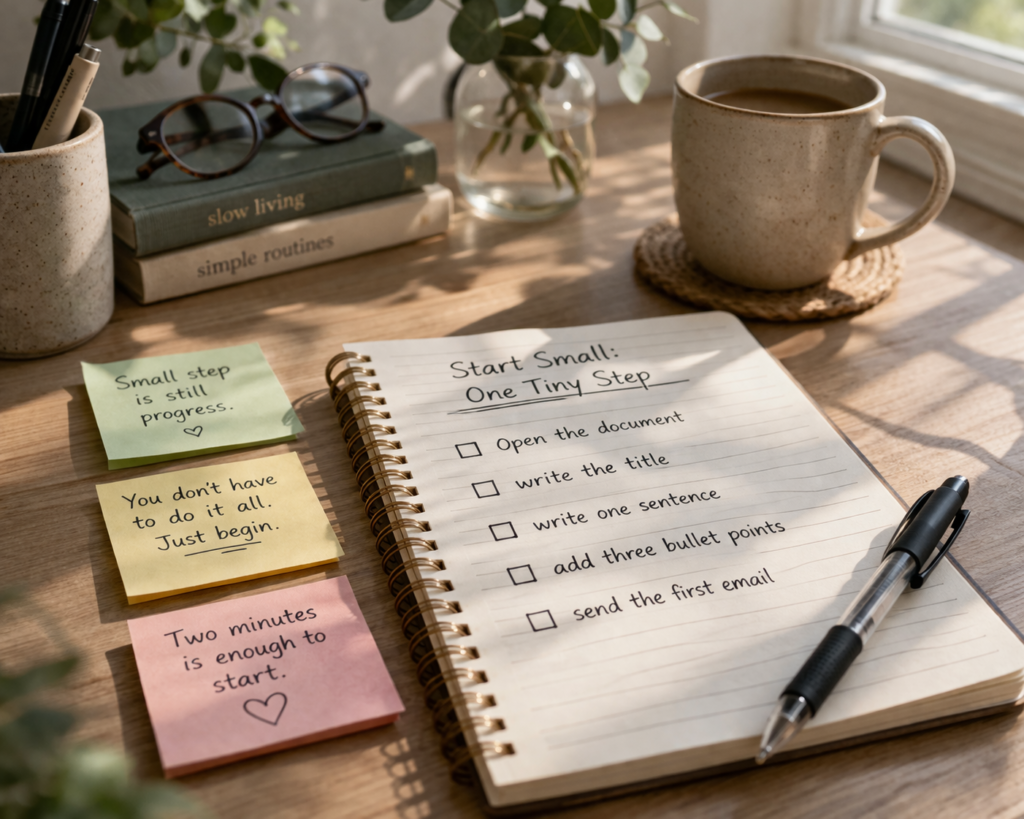
Most people already know they should break a task into smaller steps.
But their “small steps” are often still too big.
If “write the introduction” still feels heavy, go smaller:
- open the file
- write the title
- write one sentence
- list three bullet points
That counts.
Small steps reduce resistance.
And small steps done consistently build real momentum.
[Image 2 — Alt text: “breaking procrastination into small manageable steps with notes and checklist”]
5. Pair It With Something Pleasant
If a task feels dull or emotionally flat, stop pretending that does not matter.
Pair it with something your mind already enjoys.
You might:
- play a favorite instrumental playlist while doing admin
- sit in your favorite café while working on a hard task
- light a candle before beginning
- make tea before a writing session
This does not make the task magically exciting.
But it can make the emotional entry point softer.
6. Use Time Limits Instead of Pressure
Procrastination grows when a task feels endless.
A time boundary can make starting easier.
Instead of committing to finishing the whole thing, commit to working on it for:
- 10 minutes
- 15 minutes
- 25 minutes
That is all.
A fixed time block feels lighter than an undefined mountain.
You are not promising completion.
You are only creating a container for movement.
7. Practise Self-Compassion Instead of Self-Criticism
This matters more than most people realize.
When you criticize yourself for procrastinating, the task becomes even more emotionally loaded. It starts to carry shame along with pressure.
That makes avoidance more likely, not less.
Try replacing:
“Why am I like this?”
with:
“This feels hard right now. What would make it easier to start?”
Self-compassion is not letting yourself off the hook.
It is removing the extra emotional weight that keeps you stuck.
8. Change Your Environment So Starting Is Easier
Motivation is unreliable.
Environment is more predictable.
Every extra step between you and a task gives avoidance more room to grow.
Reduce friction where you can:
- keep the file open on your desktop
- place your notebook on the table the night before
- put your phone in another room
- clear your workspace before you begin
- use a blocker during your focus window
The easier it is to begin, the less you have to rely on willpower.
9. Start With the Task You Are Avoiding Most
Sometimes the thing draining your energy all day is not the amount of work.
It is the one task you keep mentally circling.
A difficult email.
A form you need to submit.
A project you keep delaying.
A conversation you do not want to have.
If possible, begin there first.
Not because you need to be extreme.
But because clearing the heaviest mental weight often makes the rest of the day feel lighter.
10. Build Momentum With Small Wins
When procrastination has been strong, confidence is usually low too.
So do not wait for a huge breakthrough.
Create one small win.
Reply to one message.
Tidy one area.
Write one paragraph.
Cross off one avoided task.
A small completion tells your mind:
“I can move.”
And once that feeling returns, the next step usually becomes easier. As Dr. Truitt’s concept of “Successive Successes” describes, each small completion sends a dopamine signal that tells your brain “doing things feels good” and that signal compounds. Momentum builds on itself. Action creates the motivation you were waiting for.
How Procrastination and Feeling Stuck Are Connected
Procrastination rarely exists in isolation.
For many people, it becomes one of the quiet reasons life starts to feel stuck.
You keep delaying the actions that would build progress.
The lack of progress creates frustration.
That frustration makes starting feel even heavier.
So the pattern keeps feeding itself.
If this feels familiar, you may also like: How to Get Out of a Rut: 5 Small Shifts When Life Feels Stuck
And if procrastination has started turning into self-criticism or emotional heaviness, you may also like: How to get out of a rut
A Simple Daily Starter Ritual
Before reaching for your phone in the morning, try this:
- Name one task you have been avoiding
- Shrink it into a two-minute version
- Do that version before doing anything else
That is it.
This ritual is small on purpose.
Done consistently, it helps interrupt the avoidance loop before it has time to take over the day.

Frequently Asked Questions
Why do I procrastinate even on things I want to do?
Because procrastination is usually about emotional discomfort, not lack of desire. You may want the outcome and still avoid the feeling attached to the task.
Is procrastination a sign of laziness?
No. Laziness suggests a lack of care. Procrastination is often the opposite. Many people procrastinate because they care deeply and feel pressure around doing something well.
What is the difference between procrastination and being in a rut?
Procrastination is usually about avoiding specific tasks. A rut is a broader feeling of stagnation. They often overlap and reinforce each other. For more on the broader picture read
Does forcing motivation ever work?
Sometimes in the short term, but usually not in a sustainable way. Pressure can create action for a moment, but it often leaves you more drained afterward.
How long does it take to break a procrastination habit?
It depends on the pattern and what is driving it. But change usually begins when you consistently reduce friction and start small, rather than waiting to feel ready.
Can procrastination be linked to something deeper?
Yes. Chronic procrastination can overlap with anxiety, perfectionism, depression, ADHD, and emotional overwhelm. If the pattern feels persistent or distressing, extra support may help.
What if I start and stop halfway through?
That still counts as progress. Starting matters. If you stop, use that as information. The task may still be too big, too vague, or too emotionally loaded.
What is the single most helpful first step?
For most people, the most helpful first step is to make the task smaller and easier to start than it was before.
Closing Reflection
The procrastination habit is not something you defeat once and never face again.
It is something you learn to work with more gently.
You do not need to feel fully ready.
You do not need to force enthusiasm.
You do not need to become a different kind of person overnight.
You only need to make the next step easier to begin.
Because action does not always come from motivation.
Sometimes motivation comes from action.
And often, the smallest beginning is enough.